

Adore ye the Lord in his holy court. Let all the earth be moved at his presence. (Psalm 95:9 DR)
Whenever we sacrifice, it is because we love something. The object of that love can certainly vary, but in sacrifice we deem the possession of that object as worth the loss of other things. Our Lord illustrates this in the parable of the pearl of great price, in which the pearl merchant finds an exceedingly precious pearl and sells all he has to possess it (cf. Matthew 13:45-46). Our Lord likens the kingdom of heaven to this pearl, with the obvious meaning that the kingdom of heaven is worth giving up all things for.
The Psalmist previously exhorted the nations to bring sacrifices to God, prophetically announcing the coming of this very kingdom in the advent of our Lord and Savior in the Incarnation. The motivation for these sacrifices is now set forth, as they are intended not merely as a propitiation to turn aside wrath but as a means of adoration of God. Thus he exhorts the nations to adore ye the Lord.
To the modern mindset—which has lost much of the concept of sacrifice—this might seem like an emotional exhortation or something that is manifested in spontaneous or ecstatic ways. But in reality this is the consummation of sacrifice, for the sacrifice itself is the act of adoration.
When our Lord offered Himself as a pleasing sacrifice to the Father, He did so as an act of perfect charity and adoration, for His will was perfectly united with that of the Father’s, both in respect to the Trinitarian mystery from all eternity but also as realized in the Incarnation and the union of the human will with the divine will in the hypostatic union. Thus, even though the human nature of our Lord in His humanity recoiled in fear from the prospect of pain and death—so much so that He sweated drops of blood in anticipation of this—His human will was so united to the Divine will that in perfect charity He despised the pain and death and willingly accepted it from God’s hand. As He says:
Therefore doth the Father love me: because I lay down my life, that I may take it again. No man taketh it away from me: but I lay it down of myself, and I have power to lay it down: and I have power to take it up again. (John 10:17-18 DR)
The end of all sacrifice to God—especially as we unite ourselves to our Lord’s One Sacrifice in the Holy Sacrifice of the Mass—is this adoration that the Psalmist speaks of. Fr. Nicholas Gihr eloquently describes this reality as found in the Eucharistic Sacrifice:
The celebration of the Eucharistic Sacrifice, indeed, contains an infinitely perfect adoration of God. Sacrifice by its nature and destination is an act of adoration and glorification of God; it is an efficacious, solemn acknowledgment of the supremacy and dominion of God over all creatures. The more perfect the Sacrifice, the greater the honor rendered to God. From this it follows that the Mass, being a sacrifice of infinite value, includes in itself infinitely worthy praise and adoration of the triune God. Upon the altar it is not merely a man who offers, it is not a mere creature who is offered, but it is the God-Man who offers Himself to the Heavenly Father as a holocaust of adoration and an incense-offering of praise. It is a Divine Person, it is the Son of God, eternal and infinite, like unto the Father and the Holy Ghost, it is Jesus Christ, the first-born of all creatures and the Head of the whole creation, who, in the Mass, according to His humanity, sacrifices and is sacrificed. Could God’s majesty and sovereignty be declared and be acknowledged more emphatically than is done upon the altar, where the Son of God, under the sacramental species, conceals, annihilates and humbles to the very depths His most glorious, noble and precious humanity, that is, sacrifices it to the honor of God? (Fr. Nicholas Gihr, The Holy Sacrifice of the Mass, Book I., Article 2., Chapter 18, 2.)
As humans we do not have the capacity to render to God what He is owed, nor does any finite creature. Only God Himself can render to God the adoration that is owed unto Him. The unsurpassable mystery of the Mass is that as we are brought into union with the Holy Sacrifice of Our Lord Jesus Christ, we can participate in that perfect homage unto the Father. When our Lord took upon Himself our nature He united us to God through His mystical Body in a manner that allows us to render homage to God that even the highest angels cannot, which is a mystery beyond words:
In our hands also Christ has placed Himself as a victim, that we may be able to offer a gift to God capable of rendering Him infinite honor and pleasure. Whilst offering the Divine Victim in the Mass, we render to God inexpressible homage and adoration, fully proportionate to His divinity and dominion. — How exceedingly joyful and happy are not the souls that love God at the thought of being able, by the Sacrifice of the Mass, worthily to honor, praise and adore the Lord of heaven and earth! (Fr. Nicholas Gihr, The Holy Sacrifice of the Mass, Book I., Article 2., Chapter 18, 3.)
This sublime mystery and reality is too great to be articulated and thus the Psalmist can only speak in terms of shakings and upheavals of the earth—“Let all the earth be moved at His presence.” The Vulgate has commoveatur, which generally has more violent undertones in respect to the movement it describes. This translates the Greek σαλευθήτω from the Septuagint, which is to shake, agitate, disturb. Thus as God draws near the otherwise solid ground is moved and shaken; even the globe of the world is displaced.
This goes beyond simply the earth as an inanimate object but is used figuratively for all men who dwell therein. Such adoration is not a fuzzy emotion but true worship and homage; the recognition of Who God is in His power and majesty. St. Jerome’s Hebrew translation has paveat for commoveatur, with paveat having the sense of being struck with fear or dread. In English it could be rendered “Let all the earth tremble before Him.” This admixture of adoration and trembling thus gets at what the Scriptures mean by the fear of the Lord.
St. Bellarmine briefly discusses whether this passage refers to the Incarnation or the Second Coming, and himself concludes it can be both:
He had hitherto seen, as it were, from afar, the kingdom of the Messias, and he exhorted preachers to announce, and people to acknowledge, the coming King; he now beholds him, as it were, at hand, sees him approaching; and, exulting in spirit, he calls upon not only all nations, but even the heavens and the earth, the seas, the very trees, to exult, and to adore him; not that he looked upon such things as imbued with reason, but in order to express the extent of his own feelings, and the universal joy that would be felt all over the world on the coming of Christ. Some will refer this passage to the first, others to the second, coming of Christ; but we see no reason why it should not take in both. He, therefore, says, “Let all the earth be moved at his presence.” Let all the inhabitants of the earth be full of fear and reverence on the approach of the Lord. (St. Robert Bellarmine, A Commentary on the Book of the Psalms, 95, 9.)
Both in the Incarnation and the Second Coming we have the earth moved at His presence, for in His first coming He toppled the order of the world, defeating death and overcoming the principalities of this world, as St. Paul describes:
Buried with him in baptism, in whom also you are risen again by the faith of the operation of God, who hath raised him up from the dead. And you, when you were dead in your sins, and the uncircumcision of your flesh; he hath quickened together with him, forgiving you all offences: Blotting out the handwriting of the decree that was against us, which was contrary to us. And he hath taken the same out of the way, fastening it to the cross: And despoiling the principalities and powers, he hath exposed them confidently in open shew, triumphing over them in himself. (Colossians 2:12-15 DR)
And in His second coming the world will again be moved:
But the day of the Lord shall come as a thief, in which the heavens shall pass away with great violence, and the elements shall be melted with heat, and the earth and the works which are in it, shall be burnt up. (2 Peter 3:10 DR)
If the unreasoning world is moved at His presence, how much more should our hearts be moved to adoration of the Lord, who is King and Lord over all and worthy of all worship and adoration. Moreover, our Lord is made truly present in the Blessed Sacrament of the altar, and thus at Mass we should be moved at His presence, in which the chains of sin are shaken off, the dullness of our minds excited and the ardor or our hearts enflamed:
Alas! Our praise of God is frequently very imperfect and worthless; therefore, we should unite it with the infinitely perfect praise and adoration which our Head and Mediator, Jesus Christ, presents to His Heavenly Father on the altar. By this union alone is our insignificant worship made holy and meritorious, so as to ascend as clouds of fragrant incense before the face of God. — Then the reflection that God is so often forgotten and despised in the world, His holy name reviled and blasphemed, should deeply wound our hearts and inflame them with holy ardor, in order, as an atonement, to praise and magnify God with greater fervor — especially by celebrating and assisting at the Holy Sacrifice of the Mass. For in the Mass from the rising to the setting of the sun the name of the Lord is infinitely extolled, and there is given to Him the greatest honor and glory. Still not our heart and lips only should praise the Lord, but our life, our whole conduct ought to be a continual praise, a perpetual adoration of God. At all times and in all places we should have God before our eyes, we should realize His blessed presence and, consequently, be profoundly penetrated with the spirit of profound reverence and adoration; then will our prayers be full of recollection and devotion, our works perfect and holy, our conversation circumspect and edifying, our thoughts noble and chaste, our desires pure and heavenly, our whole deportment modest and unassuming. (Fr. Nicholas Gihr, The Holy Sacrifice of the Mass, Book I., Article 2., Chapter 18, 3.)
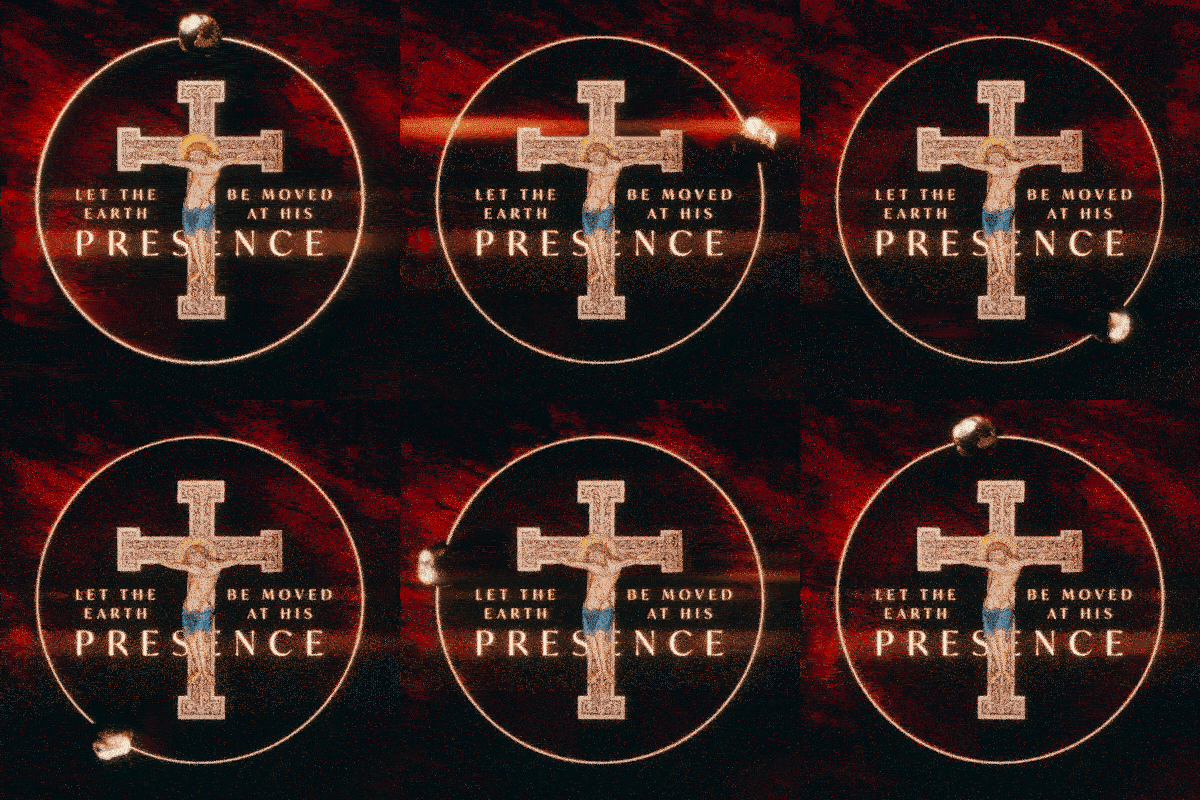
I wanted to capture this dynamic of the earth being moved at the presence of the Lord and so I found this great medieval miniature of the crucifixion and isolated it in Photoshop and brought it into After Effects.
I used Video Co-Pilot’s Orb plugin to create the earth and mapped some various textures to it and then animated revolving around the crucifix. I added some shadows using Shadow Studio 3 and then some color correction.
Enjoy.
Adore ye the Lord in his holy court. Let all the earth be moved at his presence.
(Psalm 95:9 DR)
View a higher quality version of this gif here:


