

Psalm 38:11
sometimes merciful scourges
Remove thy scourges from me. The strength of thy hand hath made me faint in rebukes: (Psalm 38:11 DR)
We generally try to avoid suffering as much as possible, and in our natural selves are inclined to perceive it as an evil to be avoided at all costs. And even when we know it will bring about some good—such as the pain of exercising so as to bring the body to health—we find it difficult to embrace. This is due to the disordered relation between our will and our appetites as a result of the Fall, so that we do not have mastery over our lower appetites to the extent that we should. Suffering and discomfort thus become obstacles to the fulfillment of our appetites and desires and are regarded as evils.
Yet the Scriptures are replete with exhortations to endure suffering, and even describe it as a means of sanctification and discipline. The Psalmist stands solidly within this tradition here as he sets the stage for the cause of his sufferings and the transformation of his mindset towards them.
It should be well noted that he does not try to absolve God of any part in his sufferings; rather, he directly attributes them to Him. As was seen in the previous passage, the Psalmist speculates that Semei’s insults towards him may have been commanded by God, and thus he sees no reason to retaliate against them, instead trusting himself to God’s mercy and vindication, which he ultimately receives. But even though he is incorrect about the cause of the insults (as God did not command Semei to do so), he is not wrong about framing his suffering within the ambit of what God allows to befall him. The Psalmist knows that although he is righteous in this particular instance, before God he is as nothing and always in need of mercy. Elsewhere he describes his mindset:
For I know my iniquity, and my sin is always before me. To thee only have I sinned, and have done evil before thee: that thou mayst be justified in thy words and mayst overcome when thou art judged. (Psalms 50:5-6 DR)
Thus, even in his righteousness he is willing to undergo the scourges of the Lord for he knows the reality of his own heart. Further, since he trusts in the Lord implicitly he has confidence that even the scourges are meant for his good, that he may be disciplined and chastened so as to be cleansed from his sin and brought to greater sanctification. It is because of God’s mercy that he is allowed to undergo suffering, just as he reasoned that he was allowed to be cursed so that perhaps later he would be justified. St. Paul explains:
And you have forgotten the consolation, which speaketh to you, as unto children, saying: My son, neglect not the discipline of the Lord; neither be thou wearied whilst thou art rebuked by him. For whom the Lord loveth, he chastiseth; and he scourgeth every son whom he receiveth. Persevere under discipline. God dealeth with you as with his sons; for what son is there, whom the father doth not correct? But if you be without chastisement, whereof all are made partakers, then are you bastards, and not sons. (Hebrews 12:5-8 DR)
If we don’t ever experience suffering we should actually be afraid, for it may mean that we have dulled our consciences so much that we are not even open to the grace of correction and thus do not receive it. As St. Paul says, if we are not chastised, then we are not sons.
This is why the Psalmist is willing to undergo the chastisement, yet still expresses the desire that it be taken away. It is not that he refuses to suffer (for we saw that he underwent it willingly) but rather that he knows that if the scourge is never removed he will perish. And since his confidence is in God’s ultimate vindication, he does not ask that it be removed either because he refuses it or because he doesn’t think it will be removed; it rather is a rhetorical circumlocution which expresses hope in God’s mercy and justice. It is as if he is saying: “Give me the chastisement sufficient for my sanctification.” St. Augustine elaborates on this:
Because it is “Thou that hast made me,” let it not be Your pleasure to destroy me utterly; scourge, so that I may be made better, not so that I faint; beat me, so that I may be beaten out to a greater length and breadth, not so that I may be ground to powder. (St. Augustine, Expositions on the Psalms, 38, 16.)
When we face trials and suffering we need to frame the experience as coming from God, whether directed specifically for our chastisement or allowed for our correction. Our confidence in His mercy allows us to hope that it will not be for our destruction but rather for our good. And even—as in the case of the Psalmist with Semei—if the cause is unjust, we can still bear it and offer it up to our Lord in union with His suffering (cf. Colossians 1:24) with confidence that God’s scourges are to make us more into children with whom He is well pleased.
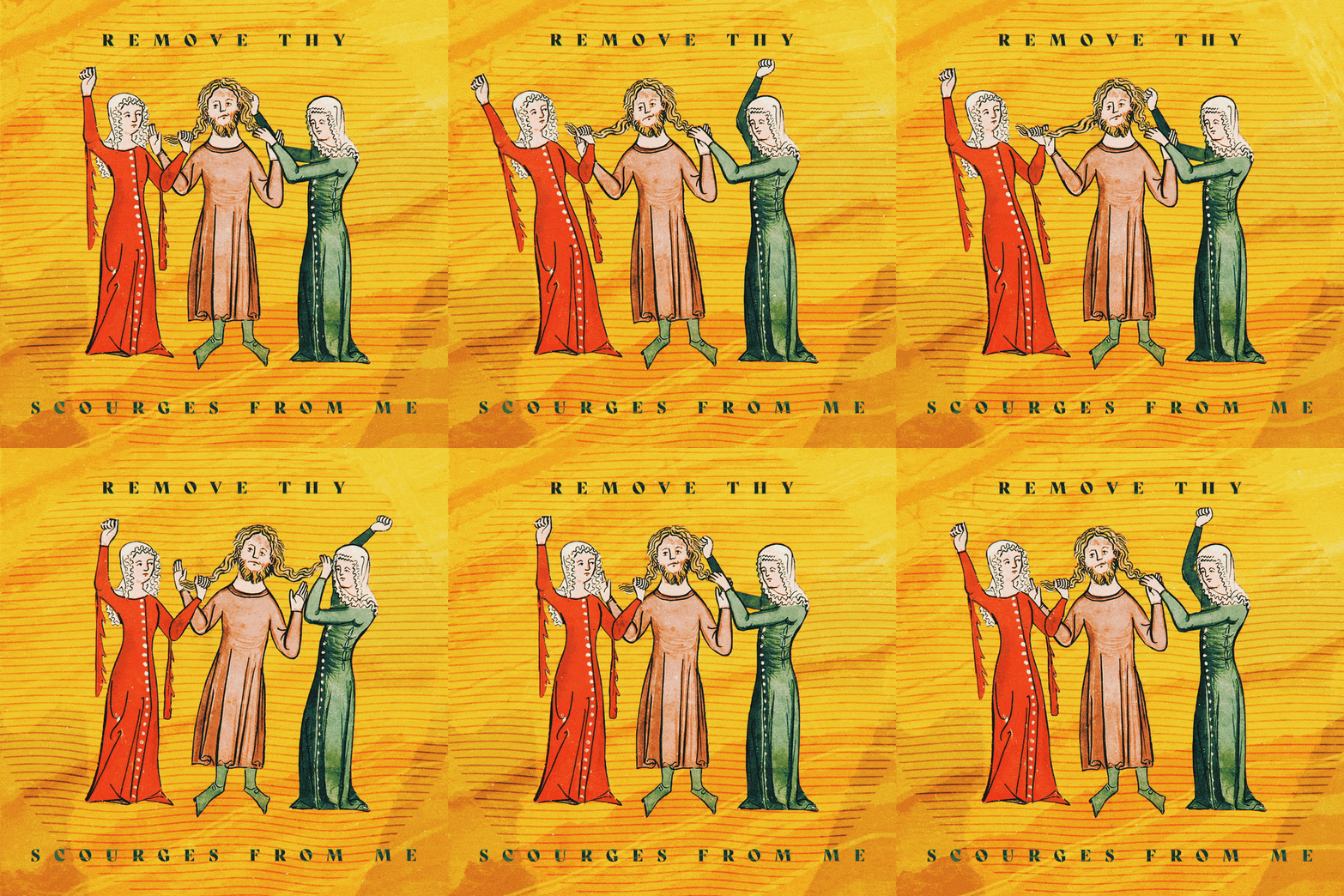
This animation was kind of accidental, in that it was only tangentially related to what I was originally looking for. I had found some medieval miniatures of Job’s suffering and came across one from the Speculum Humanae Salvationis, a work in which typology is illustrated between the Old and New Testaments. In this one there is also a typological connection drawn between the sufferings of Job and the first experience of polygamy in the Bible in the figure of Lamech. I thought that the miniature was fantastic and so I decided to go with that.

I cut out the figures in photoshop and isolated each of them and then brought each in After Effects and precomped each individually. I rigged each up with the Puppet Tool and then animated them to give the appearance of pulling Lamech back and forth and beating him, which i thought was a nice touch and probably apropos for the subject matter.
Enjoy.
Remove thy scourges from me. The strength of thy hand hath made me faint in rebukes:
(Psalm 38:11 DR)
View a higher quality version of this gif here: