

Psalm 8:4
that's no moon
For I will behold thy heavens, the works of thy fingers: the moon and the stars which thou hast founded. (Psalm 8:4 DR)
The Psalmist returns to the theme of God’s greatness being evident in creation, but with a slight variation. For in verse two this understanding is on more of a self-evident level due to the surpassing wonder of creation, whereas in verse three it arises within the humility of heart; that is, those who are humbly minded are able to perceive this greatness. Both of these modes of understanding have a certain passivity to them: creation receives its being and declares Gpd’s greatness by being what it is; the humble in heart receive wisdom from God and thus are open to perceive His wonder.
But in verse four this passivity is shifted to a direct contemplation; the Psalmist is intentionally considering the heavens, and the parallelism of the passage expands this to mean that he is not only considering creation in itself and its vast wonder, but creation as creation; that is, as the “work of Thy fingers.” St. Bellarmine notes that “fingers” has a specificity that “hands” does not:
He makes use of the phrase, “the works of thy fingers;” as much as to say, formed by your fingers, not by your arms, to show with what facility they were created by God; and furthermore, that valuable and precious works, not requiring labor but skill, are generally the work of the fingers and not of the arms. (St. Robert Bellarmine, A Commentary on the Book of the Psalms, 8, 3.)
St. Augustine perceives a mystical allusion to the Scriptures, beginning by describing that the Scriptures themselves speak of the “finger of God'“ writing the law:
We read that the law was written with the finger of God, and given through Moses, His holy servant: by which finger of God many understand the Holy Ghost. Wherefore if, by the fingers of God, we are right in understanding these same ministers filled with the Holy Ghost, by reason of this same Spirit which works in them, since by them all holy Scripture has been completed for us; we understand consistently with this, that, in this place, the books of both Testaments are called “the heavens.” (St. Augustine, Expositions on the Psalms, 8, 7.)
The meaning, then, is that the Psalmist under this reading is contemplating God’s works by means of studying the Scriptures and meditating upon them, which would create a progression as such form the opening of this Psalm:
Man perceives the wonder of creation and deduces God’s wonder and existence (cf. Romans 1:20)
The “natural” understanding of God leads to a humility of heart in the face of such grandeur and God’s wonder, which allows the humble soul to be lifted by grace above earthly contemplation (cf. James 4:10; Colossians 3:1-2)
This "heavenly” contemplation is fulfilled in the meditation upon the Scriptures n which the deep things of God are contemplated (cf. 1 Corinthians 2:9-11)
St. Robert Bellarmine indirectly supports this reading, for although he does not explicitly comment on this mystical meaning, he nevertheless speaks of why only the moon and stars are described:
Mention is not made of the sun here, for it was mostly at night that David would so turn to contemplation; that being the time most meet for it. “At midnight I rose to confess to thee,” Ps. 118; and in Ps. 62, “I will meditate on thee in the morning;” and Isaias, chap. 62. “My soul hath longed for thee in the night.” It is at night that the heavens are seen embellished with the moon and stars, “Which thou hast founded;” all created from nothing, raised by you from the foundation without having had any previous existence. (St. Robert Bellarmine, A Commentary on the Book of the Psalms, 8, 3.)
It is through the meditation upon these “works of Thy fingers” that our minds and hearts are able to contemplate eternal things, for while God is revealed in the wonder of creation, His preeminent revelation to us is through His Scriptures which culminates in the Incarnation of the Author and Word Himself:
For these heavens, that is, these books, are the works of God's fingers; for by the operation of the Holy Ghost in the Saints they were completed. For they that have regarded their own glory rather than man's salvation, have spoken without the Holy Ghost, in whom are the bowels of the mercy of God. (St. Augustine, Expositions on the Psalms, 8, 8.)
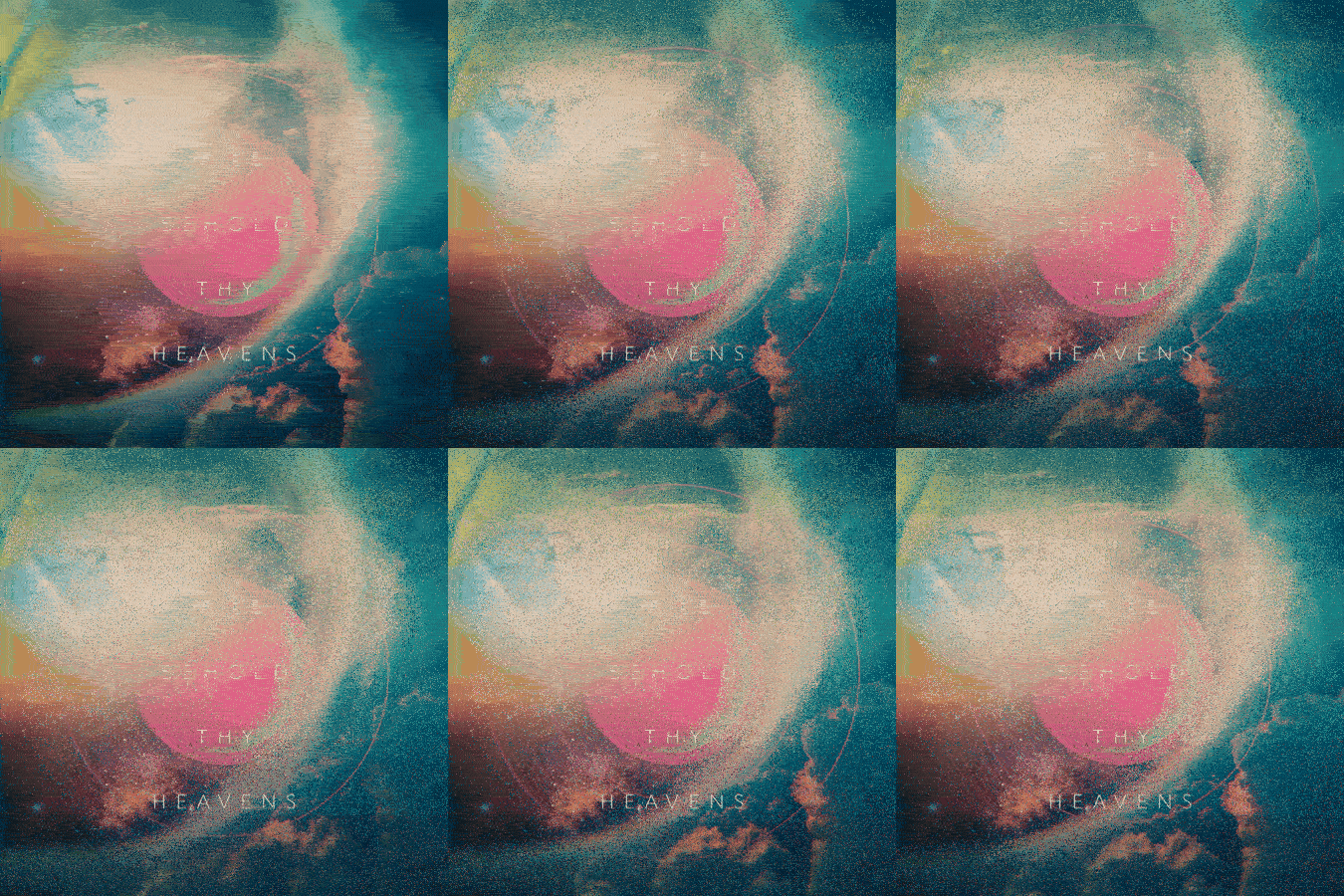
In this animation I wanted something that spoke to the notions of the “heavens” without being overly literal. I found some images of clouds and space and the moon and so decided to combine them together into a composite. I applied loopFlow to the clouds to get them to move and did the same for another lens flare like image that I blended on top. I also created some radiating lines form the moon for visual interest. The lightning-esque noise in the .gif is merely a result of compression, but I kind of like it in an accidental kind of way.
Enjoy.
For I will behold thy heavens, the works of thy fingers: the moon and the stars which thou hast founded.
(Psalm 8:4 DR)
View a higher quality version of this gif here: