

Psalm 8:5
the day of visitation
What is man that thou art mindful of him? or the son of man that thou visitest him? (Psalm 8:5 DR)
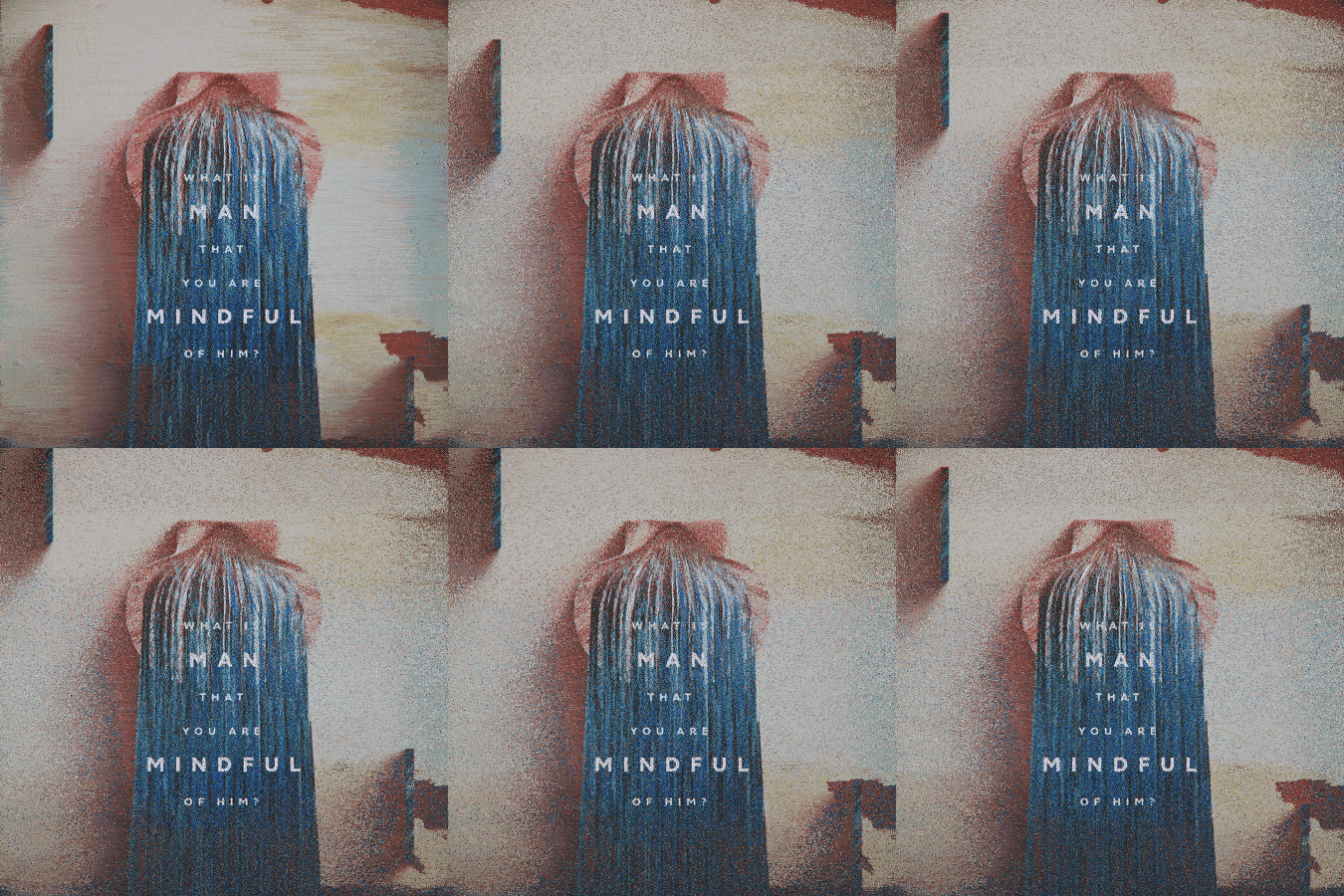
The wonder and grandeur of God as set forth in His creation of all that exists and in His revelation to man in the Scriptures is seen in its perfection in the Incarnation of our Lord, which the Psalmist now mystically prophesies.
On the literal level the import of the passage is that in comparison to the scope of creation man is relatively insignificant, and thus the Psalmist is in awe that God would be mindful of him at all, let alone “visit” him. However, St. Paul directly quotes this passage and what follows (cf. Hebrews 2:6-10) in reference to our Lord Jesus Christ, thus providing the prophetic interpretation of the Psalm. St. Augustine has this and other passages in the background as he expounds upon the way in which the distinction between “man” and “son of man” points to the reality of the Incarnation:
It may be asked, what distinction there is between man and son of man. For if there were none, it would not be expressed thus, “man, or son of man,” disjunctively. For if it were written thus, “What is man, that You are mindful of him, and son of man, that You visit him?” it might appear to be a repetition of the word “man.” But now when the expression is, “man or son of-man,” a distinction is more clearly intimated. (St. Augustine, Expositions on the Psalms, 8, 10.)
Here St. Augustine intuits the function of poetic parallelism, even though the conceptual category far postdates him. In parallelism an idea is often expanded or enlarged, or sometimes even disjunctively contrasted. This is certainly a poetic device, but it isn’t, as he understands, simply mere repetition for stylistic effect. Rather, it is meant to be a mini-commentary on the words or phrases it follows, often to draw out a meaning that is implicit but is then made more explicit. There is no hard and fast manner in which this happens (as it is poetry), but it would generally be mistake to see it as mere repetition for the sake of poetry, as ancient cultures did not see poetry as a primarily stylistic device but rather as a means to convey truth in ways more conducive to meditation and contemplation.
The disjunction between man and son of man would of course signal to Christian readers a reference to Christ, as Son of Man is one of the titles that our Lord frequently applies to Himself. But St. Augustine is not content to stop at such a reading, and inquires more penetratingly into this passage.
The first use of “man” he understands as a reference to Adam as both a historical figure and as a paradigm of the “old man” (cf. Romans 6:6). He notes that although all “sons of men” are men, not all “men” are “sons of men,” given that Adam did not have an earthly father. Following this, those who still live according the flesh (cf. Colossians 3:6-10) are signified as “men,” whereas those who are regenerated are “sons of men:”
Wherefore we may from hence consider and distinguish what is the difference in this place between man and son of man; namely, that they who bear the image of the earthy man, who is not a son of man, should be signified by the name of men; but that they who bear the image of the heavenly Man, [1 Corinthians 15:49] should be rather called sons of men; for the former again is called the old man and the latter the new; but the new is born of the old, since spiritual regeneration is begun by a change of an earthy, and worldly life; and therefore the latter is called son of man. “Man” then in this place is earthy, but “son of man” heavenly; and the former is far removed from God, but the latter present with God; and therefore is He mindful of the former, as in far distance from Him; but the latter He visits, with whom being present He enlightens him with His countenance. (ibid.)
St. Paul makes a similar argument, expounding upon the distinction between the natural self and the one who has been quickened by grace:
And you, when you were dead in your offences, and sins, wherein in time past you walked according to the course of this world, according to the prince of the power of this air, of the spirit that now worketh on the children of unbelief: In which also we all conversed in time past, in the desires of our flesh, fulfilling the will of the flesh and of our thoughts, and were by nature children of wrath, even as the rest: But God, (who is rich in mercy,) for his exceeding charity wherewith he loved us, even when we were dead in sins, hath quickened us together in Christ, (by whose grace you are saved,) and hath raised us up together, and hath made us sit together in the heavenly places, through Christ Jesus. (Ephesians 2:1-6 DR)
This “quickening” is conceptually identical to being a “son of man” in the sense St. Augustine reads of this Psalm, as those who are “quickened” in Christ are born anew to become sons (cf. John 1:12-13) of the heavenly man (cf. 1 Corinthians 15:49) who is our Lord Jesus Christ. He is the author and finisher (cf. Hebrews 12:2) of that self-same faith which brings us to be sons. He as the Son of Man came to the sons of man in the Incarnation:
Therefore was the son of man first visited in the person of the very Lord Man, born of the Virgin Mary. (St. Augustine, Expositions on the Psalms, 8, 11.)
God’s mindfulness of man and charity towards him (cf. Romans 5:8) is thus fulfilled in the coming of the Son of Man to make us into sons of the heavenly man, as St. Paul succinctly concludes:
But when the fulness of the time was come, God sent his Son, made of a woman, made under the law: That he might redeem them who were under the law: that we might receive the adoption of sons. (Galatians 4:4-5 DR)
Through the spiritual regeneration that St. Augustine describes—which is of course the sacrament of Baptism—we are born into a new life (cf. Romans 6:3-4) and made sons of God.
For this animation I wanted to focus on the spiritual regeneration aspect, and so I naturally needed some baptism imagery. I found this excellent image of an old drawing of a shell which was a proposed (and probably realized) design to be used in baptisms, the shell being an ancient icon of the sacrament.
I cut it out in Photoshop and brought the image into After Effects. I also found a good image of some water and precomped it and applied Stretch to it, modifying the parameters until I got a great looking “flow” to the water. I used some masks and mattes to make it appear as if it were flowing forth from the shell.
I precomped that same water image and matted it to some rectangles and animated those on the sides for some compositional balance. I then applied Shadow Studio 3 to the shell precomp and the other precomps for some nice depth and shading and finally added some color correction to complete the project.
Enjoy.
What is man that thou art mindful of him? or the son of man that thou visitest him?
(Psalm 8:5 DR)
View a higher quality version of this gif here: