

Psalm 9:18
a hell of a round-trip
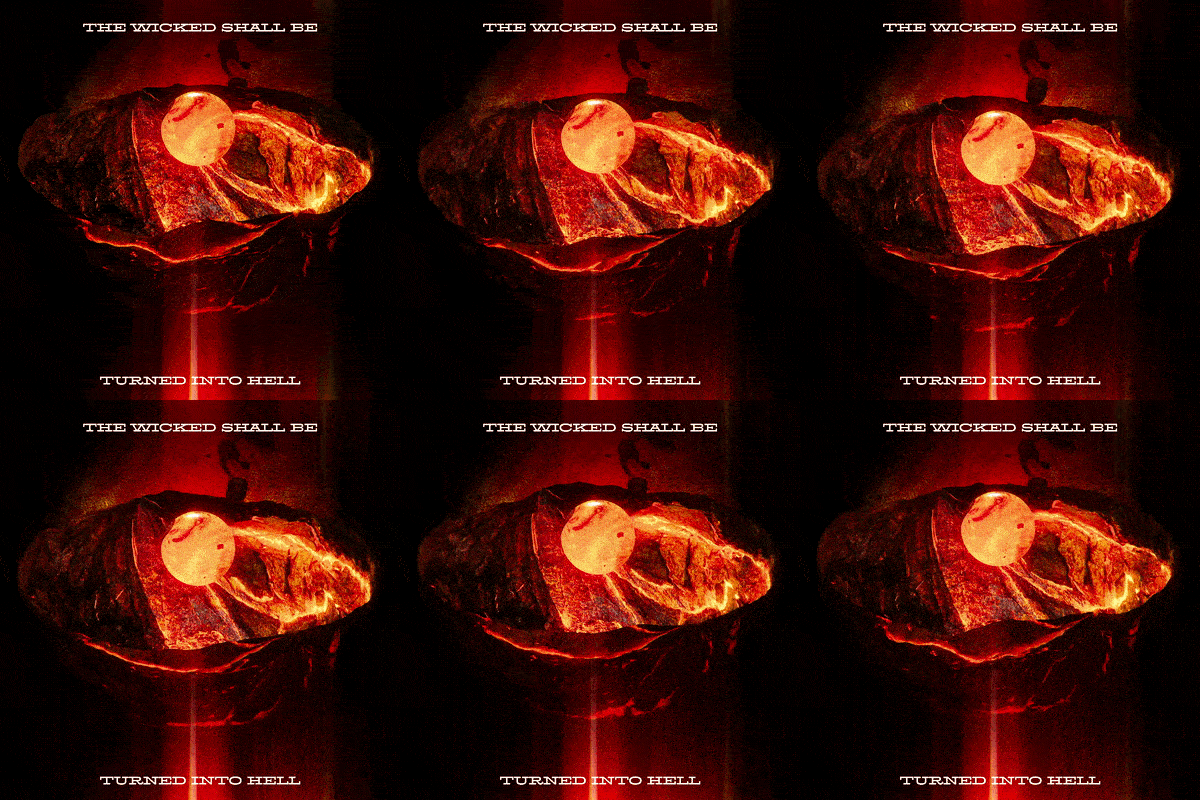
The wicked shall be turned into hell, all the nations that forget God. (Psalm 9:18 DR)
The Septuagint and Old Latin preserve a musical notation between the previous passage and this one which reads: canticum diapsalmatis. “Diapsalma” means “pause,” and thus this is a “pause in the song” or, as St. Augustine renders it, “the song of the diapsalma.” He understands this pause as forming a notional separation between the righteous and the wicked:
Here is interposed, “The song of the diapsalma” [Psalm 9:16]: as it were the hidden joy, as far as we can imagine, of the separation which is now made, not in place, but in the affections of the heart, between sinners and the righteous, as of the grain from the chaff, as yet on the floor. (St. Augustine, Expositions on the Psalms, 9, 17.)
It will be remembered from the beginning of this Psalm that an aspect of the “hidden things of the Son” is that future judgment which is to come on the Last Day, which is prefigured in the “hidden” judgment of sin in each man’s heart according to his deeds:
The hidden judgment accordingly is the pain, by which now each man is either exercised to purification, or warned to conversion, or if he despise the calling and discipline of God, is blinded unto damnation. (St. Augustine, Expositions on the Psalms, 9, 1.)
This pause in the Psalm is thus a moment to reflect and meditate upon the end of both the righteous and the wicked, the former to eternal glory and the latter to eternal pain. The virtues and vices of this life are foreshadowings—as it were—of those ends, and thus while still in this we would do well to consider our hearts and wills and whether they are oriented towards purity and holiness or subjected to the ravages of concupiscence and sin.
St. Bellarmine notes that this being turned into hell is itself a return:
To be taken as a prophecy, not as an imprecation. “Shall be turned,” means in the Hebrew, “shall return;” which is applied to sinners, inasmuch as the devil, when he seduced them, made them his slaves; and, therefore, they will return to him. For God created man in innocence: the devil made him a sinner. As our Savior, in Jn. 8, says, “You are from your father, the devil.” (St. Robert Bellarmine, A Commentary on the Book of the Psalms, 9, 17.)
St. Augustine sees this turning as following directly form the previous two passages which describe the consequences of sin and how sin becomes its own punishment, as it were:
And then follows, “Let the sinners be turned into hell” [Psalm 9:17]: that is, let them be given into their own hands, when they are spared, and let them be ensnared in deadly delight. (St. Augustine, Expositions on the Psalms, 9, 17.)
There is a sobering reality to these words of St. Augustine, for he speaks of how subtly and surreptitiously sin can ensnare the soul. If we consider the previous two passages, those who are turned into hell are characterized by being caught in their own devices:
A. The Gentiles have stuck fast in the destruction which they have prepared. (v. 16)
B. Their foot hath been taken in the very snare which they hid. (v. 16)
C. The sinner hath been caught in the works of his own hands. (v. 17)
All of these are the consequences of the sin itself, the blowback of evil upon its perpetrator. They think they are secure in their actions and perhaps even find temporal success, but all these machinations are sowing the seeds of their own destruction and become the snare into which they eventually fall.
St. Augustine says—in words that should make us sober-minded—that when “they are spared” they are then “ensnared in deadly delight.” That is, their evil deeds do not always bring about an evil result to them in the temporal order; they often find great success in this life and enjoy the pleasures of this world, often in great abundance. This is the means by which they consider themselves to be spared and may even imagine that their success is a blessing from God and thus an affirmation of their actions. However, in thinking thus they deceive themselves, for this success and accumulation of temporal goods and pleasures builds the trap that will ensnare them forever, and the eternal irony is that their own hands build the cage. St. James describes the deceit of sin and the pleasures of temptation that lead to eternal ruin:
But every man is tempted by his own concupiscence, being drawn away and allured. Then when concupiscence hath conceived, it bringeth forth sin. But sin, when it is completed, begetteth death. (James 1:14-15 DR)
The Psalmist expands upon this thought in the second half of the passage which illuminates the ultimate cause of the sinner returning to hell: they forget God. Their wickedness is not something they accidentally fall into so that hell is some sort of oops, I didn’t know… sort of reality. Instead, this forgetting is a deliberate act as the Psalmist has been describing, for the machinations of the wicked against the righteous is an intentional act of malice against what is Good and True and Beautiful and thus ultimately against God Himself.
St. Bellarmine’s linking of sinners to the devil as their father is apropos since the devil was the first to forget God in this manner. It is not that the devil is not mindful of God—he cannot help but behold the Lord in His agonizing (to the devil) splendor (cf. James 2:19). Rather he chooses to set himself against God and in his manner forgets Him, and when we set our will against God’s law we do likewise:
The latter part of the verse, “all the nations that forget God,” declares who the sinners are that “will return to hell:” namely, all those “who forget God.” For the forgetting of God is the root of all sin; for he who sins turns away from God unto the creature. (St. Robert Bellarmine, A Commentary on the Book of the Psalms, 9, 17.)
The result of this miasma of forgetfulness in our turning from God is a darkening of our intellects and a hardening of our hearts:
All the nations that forget God. Because “when they did not think good to retain God in their knowledge, God gave them over to a reprobate mind.” [Romans 1:28] (St. Augustine, Expositions on the Psalms, 9, 17.)
As St. Paul further relates in the passage St. Augustine quoted above, this darkening of the intellect coincides with a descent into further depravity and a turning of the mind and will to lesser created things. This leads—as St. James noted—to the tyranny of concupiscence over the will so that we get dragged into sin and death by our own appetites. The irony, of course, is that our appetites are meant to serve the end of our flourishing, but in the depravity of sin get twisted into serving the destruction of the soul.
In our default natural state because of Original Sin we are sons of the devil, slaves to sin on a return trip to hell. When we turn our wills to created things rather than to the Creator we become like the nations in this passage that forget God, which is the root of all our sin. However, due to the boundless love of God we can be turned from hell to heaven; rather, instead of returning to hell as children of the devil we can return to heaven as children of God. Through the justification merited for us by our Lord Jesus Christ we can be translated from the kingdom of death to the kingdom of life, as the Council of Trent admirably describes:
This disposition, or preparation, is followed by Justification itself, which is not remission of sins merely, but also the sanctification and renewal of the inward man, through the voluntary reception of the grace, and of the gifts, whereby man of unjust becomes just, and of an enemy a friend, that so he may be an heir according to hope of life everlasting…
For, although no one can be just, but he to whom the merits of the Passion of our Lord Jesus Christ are communicated, yet is this done in the said justification of the impious, when by the merit of that same most holy Passion, the charity of God is poured forth, by the Holy Spirit, in the hearts of those that are justified, and is inherent therein: whence, man, through Jesus Christ, in whom he is ingrafted, receives, in the said justification, together with the remission of sins, all these (gifts) infused at once, faith, hope, and charity. (Council of Trent, Session VI, Chapter VII.)
I guess it could be said that I went sort of literal with this one, although I’m not sure how literal one can be with a depiction of hell. At any rate, I opted for what could be described as a colloquial conception in terms of fire and used Trapcode Mir to create this bowl or clamshell which uses an image as a texture for the mesh.
I added in a floating orb that never quite falls into it to kind of get at the provisional nature of this end in respect to one’s life; that is, in our natural state we are hovering over the abyss, as it were, but as long as we are alive there is hope to be redeemed.
I added in some lights and glow to give it a contrasty vibe and draw out some of the fire colors.
Enjoy.
The wicked shall be turned into hell, all the nations that forget God.
(Psalm 9:18 DR)
View a higher quality version of this gif here: