

Psalm 9:31
the pride of crouching vs. the humility of kneeling
In his net he will bring him down, he will crouch and fall, when he shall have power over the poor. (Psalm 9:31 DR)
The hidden judgment of God which St. Augustine expounded upon in the beginning of this Psalm is finally manifest to those with eyes to see, but since it is a hidden judgment prior to the final judgment on the Last Day it is not as apparent as might otherwise be.
As the Psalmist continues his prophetic vision of the coming of the Antichrist, he sees in his rise to power both his destructive reign and the downfall of that same man of sin which is facilitated by his actions.
The first half of this passage concerns his persecution of the righteous in the Church who are characterized as the poor in the preceding passage. St. Augustine understands this as a mutually reinforcing opposition between vice and virtue, and as one rises the other falls. In this case the rise of the Antichrist through the signs and wonders he will perform will bring about a concomitant rejection of the Church:
And well does he say, “He will humble him in his snare.” For when he shall begin to do those signs, the more wonderful they shall appear to men, the more those Saints that shall be then will be despised, and, as it were, set at nought: he, whom they shall resist by righteousness and innocence, shall seem to overcome by the marvels that he does. (St. Augustine, Expositions on the Psalms, 9, 28.)
This deceit on the part of the man of sin is not merely wowing the world with parlor tricks so that they find him fascinating and are mesmerized in his thrall. That is a part of the deception, but his doctrine will be a totalizing one in which he sets himself up above God and is worshipped as God (cf. 2 Thessalonians 2:4). But since he is the man of sin, his doctrine is the doctrine of demons and will—as noted earlier—be a perversion and inversion of good and evil. It is not merely that he will do evil things, which rulers have done to one extent or another from time immemorial. Rather, he will attempt to make evil into good and good into evil and get the world to believe the same. This is the totalization of his doctrine which extends to every aspect of life and belief as emblemized in the mark of the beast:
And he shall make all, both little and great, rich and poor, freemen and bondmen, to have a character in their right hand, or on their foreheads. And that no man might buy or sell, but he that hath the character, or the name of the beast, or the number of his name. (Apocalypse 13:16-17 DR)
The exact identification of the mark is ancillary to the totalization that it represents and why it will necessarily involve the persecution of the Church, for evil cannot abide the presence of good. The Psalmist thus prophesies the near destruction of the Church which the Antichrist will bring down.
One might hope—lulled by as false sense of security or naivete—that such outright persecution and pervasiveness evil might cause the people of the world to wake up and no comply. But one only need to take stock of our current tolerance or or outright support of evil to lay such hopes to rest. For the deception that currently holds sway and enables such complicity in horrific atrocities such as abortion is merely the demonic birth pangs of what is come with the man of sin. His setting himself up as God will only be able to occur because he will seduce the world will promises of peace and prosperity and—for a time—seemingly deliver on those promises. He will be a false Messiah who will seem to have done what the true Messiah could not, which is to bring mankind to a heaven one earth.
The price of such seeming goods will be the deliberate embrace of evil, which is why the persecution of the Church will not be a sad yet necessary thing but rather a virtuous act, for the Church will be seen as standing in the way of humanity’s glorious future. When current pundits and talking heads accuse the Church of wanting to take us back to the Middle Ages, they have on their lips the poison of antichrist, for its not a particular period per se that they despise, but rather that the Church still exists and does not get fully on board with the Zeitheist, despite some of her prelates’ best efforts.
However, even though the Psalmist foresees the Church being driven to the brink, the hidden judgment of the Son is also hidden in the mystery of the Church’s passion, for the very persecution which the Antichrist and his followers will bring against her is the cause of his ultimate judgment and overthrow. He crouches down so as to better bring her down, like the lion lying in wait or the hunter with a net, but this posture of deceit puts him off-balance, as it were, and leads to himself falling over. It is when he seems to be at his strongest—when he has power over the poor—that his judgment is ripe:
Still, they do not get up to this with impunity: when they exert their power, when they seem to prevail, when they think they are unassailable, then it is they perish, so that the inventiveness of God, the patience of the poor, the errors of these miscreants and the forbearance of God’s long-suffering may come to light. Hence it is that justice does not follow close on their heels, since God in His long-suffering summons them to repentance; but when they profit nothing from the long-suffering, then He admonishes them with retribution. (St. Chrysostom, Commentary on the Psalms, 10.10., ACCS VII.)
In their pride the Antichrist and those who follow him will war against the Church and against God Himself, but will come to destruction just as they think their victory is nigh. Their hubris makes them feel invincible, but it blinds them to the reality that was evidenced in the primordial battle between St. Michael and Satan as evidenced in St. Michael’s very name: Who is like God? In his vanity the devil said in his heart that he would ascend to the Highest, yet in this very act was cast down; when he thought he was the strongest he was overcome.
In our fallen nature we often struggle with pride, and while we probably do not often consciously think we will ascend to the Highest, every sin is this same attempt to wing our way to supplant God, for it is a defiance against Him and His law. The humility of our Lord—Who though He is God—emptied Himself so as to assume our nature is the antidote to this wound of pride which festers within our souls. In imitation of Him we must empty ourselves of pride and self-regard, to humbly implore His mercy and rely upon His grace, especially as graciously dispensed within the Sacraments of the Church. We should have a sober view of ourselves, as St. Paul recommends:
Wherefore he that thinketh himself to stand, let him take heed lest he fall. Let no temptation take hold on you, but such as is human. And God is faithful, who will not suffer you to be tempted above that which you are able: but will make also with temptation issue, that you may be able to bear it. (1 Corinthians 10:12-13 DR)
Sometimes when I am praying the Glorious Mysteries of the Rosary I am particularly struck by the fifth, the Coronation of the Blessed Virgin Mary as Queen of Heaven and Earth. In my meditations on this I sometimes ponder how as Queen of both Heaven and Earth she thus has authority over the angels. What strikes me about this is that on a purely ontological level she as a human being is lower than the angels, yet by means of the grace bestowed on her in the Immaculate Conception and her becoming the Mother of God she was thus elevated above the angels so as to reign over them. This is perhaps the ultimate example of how grace builds upon and perfects nature, for just as her Son humbled Himself and received the Name above every name (cf. Philippians 2:9), so she imitated His humility in her submission to the will of God and was in a similar manner exalted.
This is the power of humility over pride. Pride causes one to crouch down so as to grab or capture what one desires; this posture (as mentioned above) places one off-balance and causes an inevitable fall. Humility, on the other hand, places one on one’s knees or on one’s face in adoration and submission; that is, the posture of humility means that one cannot fall but can only be exalted by grace:
Be humbled in the sight of the Lord, and he will exalt you. (James 4:10 DR)
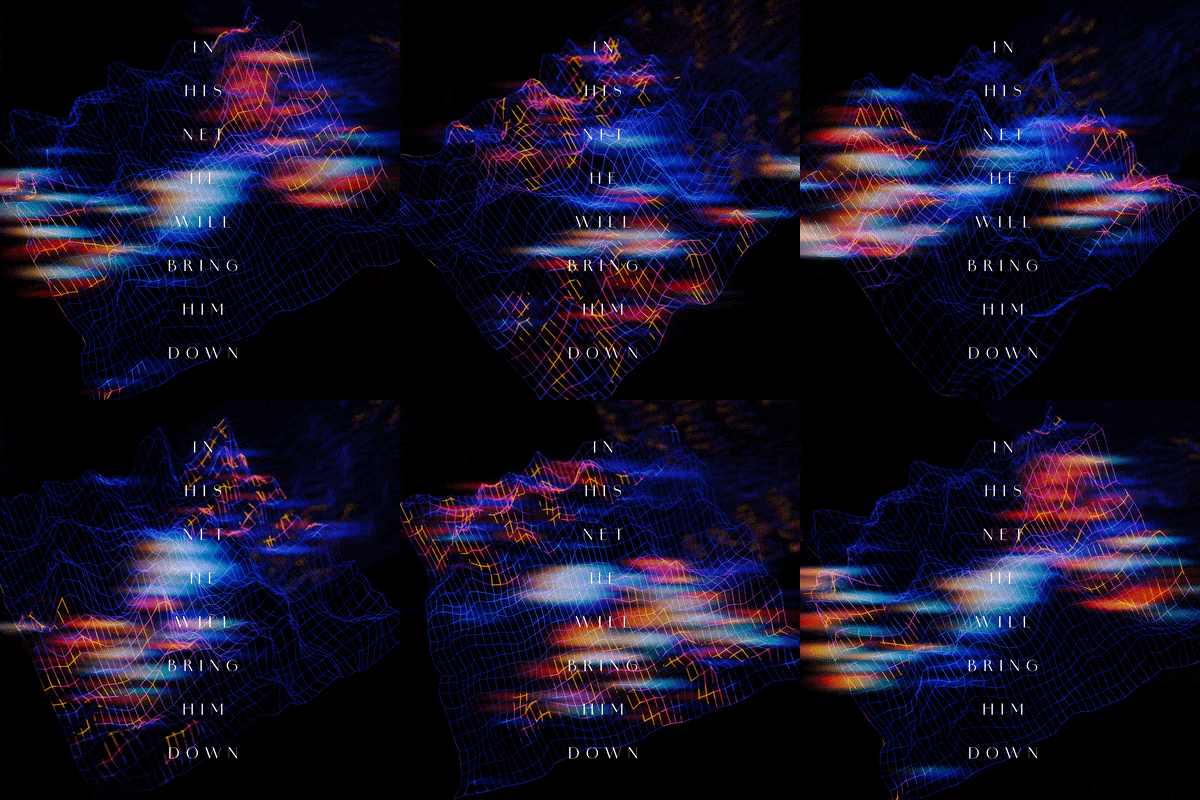
I thought it might be interesting to make something net-like for this animation, so I turned to the ever-useful Trapcode Mir, which makes these easily generatable meshes. This one basically is just a plane with some slight amplitude modulation so I could get some animation. I then animated the entire rotation of it and added in some color correction and chromatic blur for fun.
The .gif compression kind of murdered this one. Oh well.
Enjoy.
In his net he will bring him down, he will crouch and fall, when he shall have power over the poor.
(Psalm 9:31 DR)
View a higher quality version of this gif here: