

Psalm 9:34
the lie that everyone can see
Wherefore hath the wicked provoked God? for he hath said in his heart: He will not require it. (Psalm 9:34 DR)
When we consider the actions of others—especially those that are gravely evil or seemingly mindless, we often inquire into the motivation. This is evident every time there is some sort of mass act of violence and we search out the offender’s social media, contacts, associations, manifestos, etc., all in an effort to understand the “why” behind the act.
Many times such motivations lie under the surface. How often in the wake of a tragedy are there people closest to the offender stating that they saw no warning signs or that this person was a “normal” person? Sometimes there are red flags or other hints that something is off, and sometimes the offender details exactly why they are doing what they choose to do, but the human heart is in the end a mystery, often even our own to ourselves.
However hidden the motives and intentions of the heart, there is One Who sees all and knows the deepest recesses of our acts and will, and the Psalmist brings this into focus. This passage is on the surface a repetition of verse 32, but it is now on the lips of the righteous who see the motives and acts of the wicked laid bare before the tribunal of God. Whereas the wicked himself (in the person of the Antichrist) had said the things he said in his heart, now those thoughts and intents are known to all as he (and all the wicked) are judged.
This question thus becomes rhetorical and exposes the mystery of iniquity in its full force as the deliberate rejection of God’s rule, the everlastingly petulant whining of the soul which desires its own rights and what it thinks is owed to it. The righteous ask—as the Antichrist and those who follow him are being judged—why the wicked decided to provoke God. The term used in the Vulgate is irritavit, which has an obvious English cognate, meaning to incite, instigate or provoke, colored by the sense of exasperation or irritation. Both follow the Septuagint παρώξυνεν from which the term paroxysm is derived, which is generally a burst of emotion or a convulsion of some kind. The idea here it that the patience of God has—metaphorically of course—reached its limit and now judgment issues forth like the bursting of a dam.
And while these sins are myriad in their actual acts, at bottom they arise from this prideful stance that utterly rejects God. St. Jerome’s Latin translation of the Hebrew brings this out in that this provocation is at bottom blasphemy (blasphemat). The devil in his primordial pride said within his heart that he would ascend (cf. Isaiah 14:14), which is to say that he would “be like the most High.” St. Michael’s rebuke of him was “Who is like God?” This is the battle between the angels, not one of military arms (as awesome as those images are) but of concepts and ultimately of worship: between blasphemy and adoration. These two concepts are mutually exclusive and thus the war in heaven between the angels was a liturgical war; is the heart to be directed towards oneself or towards God?
The Psalmist thus provides the answer of the question asked by the righteous, for they now see—in the clarity of God’s judgment—what was in the heart of the wicked as manifested through their actions. In verse 32 the Antichrist and his followers say within themselves that “God hath forgotten,” but now this very motivation is apparent to all as they are judged. In this passage the sense is slightly expanded in that the wicked said “God will not require it.” We have seen this sense of require earlier in verse 13 which is used archaically to mean “look into” or “search out.”
This draws out the hardening of the heart that sin brings about when it becomes habitual. The wicked begin in their wickedness perhaps with trepidation, perhaps fearing judgment but still desirous of the pleasures of the sin or the exercise of the will for its own desires. When the sin is not immediately punished—that is, when no lightning bolt falls from the sky in their puerile conception of judgement—they imagine in their hearts that “God hath forgotten.” Without contrition this will confirm them in their sin, as it were, and the will is turned more towards that choice of self-will over against submitting to God’s will. The end result is indifference towards judgment, such that they say finally that “God will not require it.” That is, they imagine Him either indifferent towards the sin or powerless to do anything about it.
This lays bare the great deception of the devil, which he whispered to our first parents in the garden. He said to them in direct contradiction to God’s own words that “No, you shall not die the death” (Genesis 3:4 DR). What makes this deception so incredible is that the devil himself knows with perfect clarity and certainty that he will “die the death.” He is not himself deceived about the future judgment, for the nature of the angelic intellect is to know things immediately without discursive reasoning. They apprehend an essence and intuit it as it is without mediation. He thus was fully cognizant of the consequences of his rebellion yet chose them anyway rather than submit to God.
We, however, can be deceived about this end because there is this lag (so to speak) between the essence of a thing and our understanding of it. We come to know things discursively, and thus this mediated knowledge can go wrong either unintentionally or intentionally. We can start off with a bad premise and reach a bad conclusion, or we can (and often do) choose to ignore the conclusion that might be staring us in the face.
In this manner we often deceive ourselves into thinking that judgment will never come, saying within our hearts that God will not “require it.” We all have a built-in concept of justice which—even if malformed—nevertheless bristles at what we consider wrongs being done to us, even if intellectually we try to relativize all morality. This often inchoate sense of justice does not end with our own intellect but points to a justice that is higher and to which our consciences attest despite our often herculean efforts to sear or suppress them.
The Psalmist frames this passage as the righteous beholding the motives of the wicked, but it also serves as a warning for us all for a proper examination of conscience, for every sin to one extent or another presumes that “God will not require it.” We must rather turns our wills towards the Lord in humility, imploring of him the poverty of spirit that brings blessedness and the eternal kingdom (cf. Matthew 5:3).
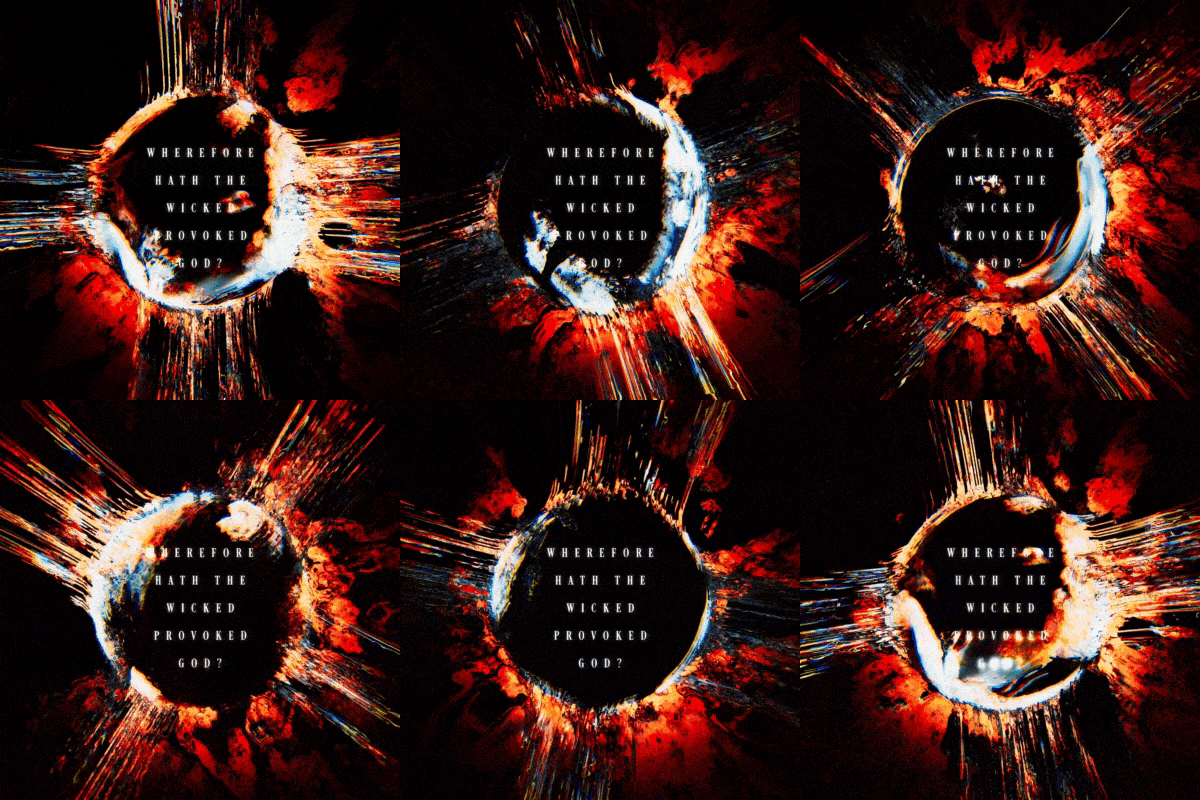
I wanted something kind of abstract for this animation and created this orb like look using Video Copilot’s Orb plugin. I liked how it kind of felt like an eye without looking exactly like an eye, which I thought would fit the passage nicely. I brought in some textures and mapped them to the various texture and illumination maps within the plugin and then simply animated the rotation of the orb.
I then drew some simple masks at 90 degree angles to each other and applied a couple instances of Stretch to flare out the orb to the edges. I added in some Chromatic Aberration to intensify the effect. I finally added in a texture behind everything and applied Turbulent Displace to have this roiling effect in the background. With some text and overall color correction it was complete.
Enjoy.
Wherefore hath the wicked provoked God? for he hath said in his heart: He will not require it.
(Psalm 9:34 DR)
View a higher quality version of this gif here: