

Psalm 38:14
the cure for nihilism
O forgive me, that I may be refreshed, before I go hence, and be no more. (Psalm 38:14 DR)
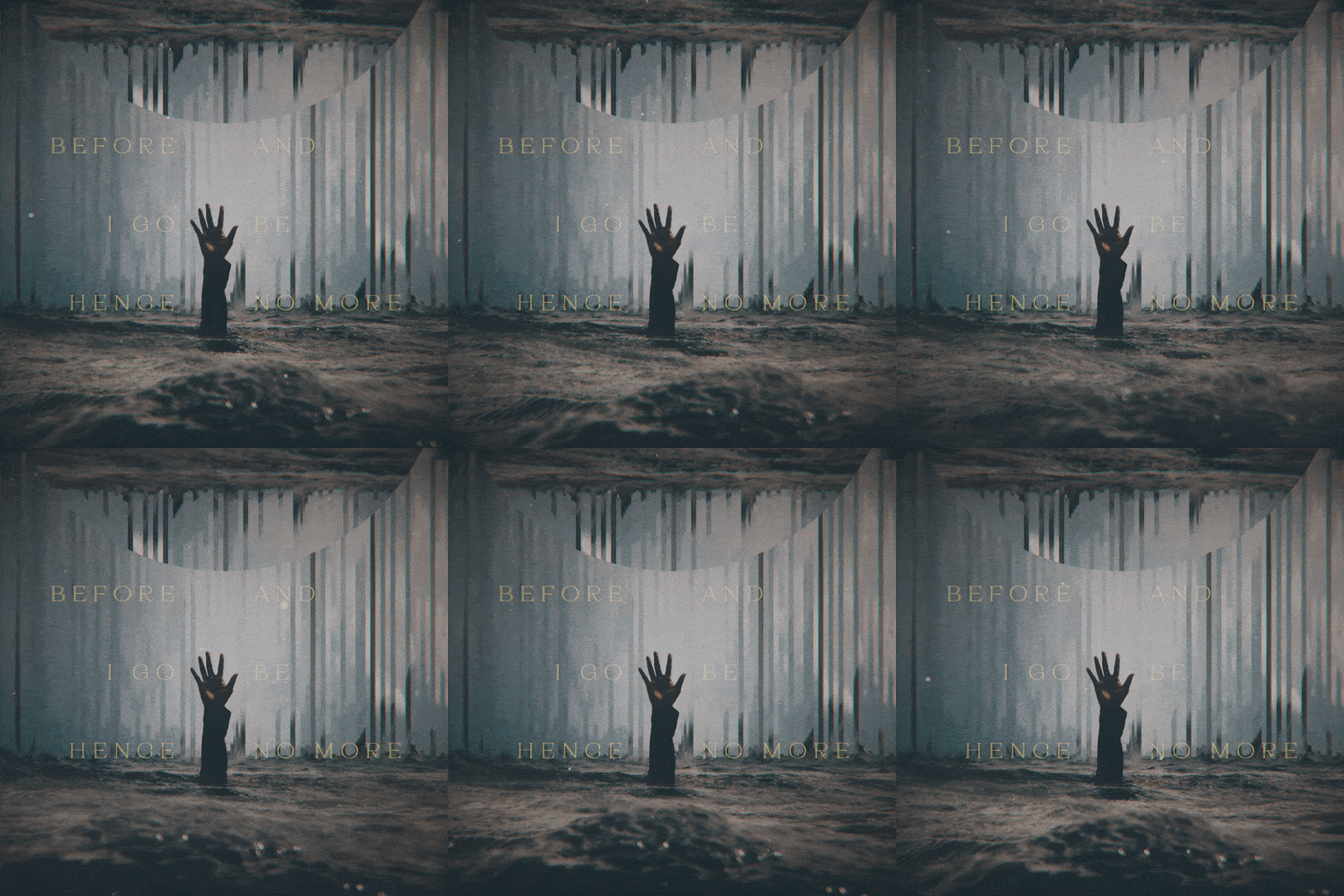
The Psalmist concludes this Psalm with what some might see as ambivalence, for whereas many Psalms end on what we might call a “hopeful” or confident note, this one ends with stark reality.
For it seems on a surface reading that all his confidence in the Lord, his realization of the fragility of life and the vanity of this world—all of those considerations seem to be swallowed up by a final despair, a capitulation to the inevitability of the yawning void of dismeaning. After all, what else is meant by the final line: “before I go hence, and be no more?” Does this not obviate all that come before, as if he were deluding himself into something more than the nothingness that he is?
However, as with many passages in the Psalms, the parallelism of the poetic structure means that the second half of the passage often elaborates or expands upon the initial clause; sometimes by buttressing and enlarging the thought, sometimes by paradox or coming at it from another angle. The same is naturally true here, for the emptiness to which he looks at at horizon is predicated on the accomplishment (or lack thereof) of forgiveness.
It will be remembered from earlier that the Psalmist spoke of the shortness of his days, which St. Augustine interpreted as drawing a necessary distinction between the transitory “days” of this world and those of eternity. The former are, as he says, days which are and are not; the transitory nature of them means that their “being” is a sort of quasi-existence, when “being” simpliciter implies permanence. The “end” of man thus cannot be found in this world and its being-not-being, but rather is found in eternity and thus in God Himself.
It is this framework which provides the key to this concluding passage. Man without God is lost in his sins, sin being, so to speak, that which is a diminution of being. Since we receive being from God, and since sin separates us from God, sin is (as it were) a kind of non-being; it makes us into less than we are meant to be. Man was created to be in communion with God, and that original state entailed the possession through grace of original righteousness by which man could attain that union. However, through the Fall that original righteousness was lost and all of Adam’s descendants bear that wound in their being by which we cannot of ourselves fulfill God’s commandments and thus live in charity with God (cf. John 14:5). We are, in a sense, like birds who are meant to fly but born without wings.
The Psalmist understands that it is his sin which precludes this union with God; this is why those who “leap-over” are careful to keep themselves from it and entrust and commend themselves to God’s grace to help them resist its allure. The natural conclusion, then, is that if he isn’t forgiven and refreshed—by which he means attaining union with God—then he will naturally slide back into the diminution that sin brings, and thus will “be no more.” This refreshment for the souls of those who “leap-over” is entreated in the Canon of the Mass in the Memento:
Meménto étiam, Dómine, famulórum famularúmque tuárum N. et N., qui nos præcessérunt cum signo fídei, et dórmiunt in somno pacis. Ipsis, Dómine, et ómnibus in Christo quiescéntibus locum refrigérii, lucis, et pacis, ut indúlgeas, deprecámur. Per eúndem Christum, Dóminum nostrum. Amen.
Remember also, O Lord, Thy servants and handmaids N. and N., who are gone before us with the sign of faith, and rest in the sleep of peace. To these, O Lord, and to all that rest in Christ, grant, we beseech Thee, a place of refreshment, light, and peace; Through the same Christ our Lord. Amen.
Like this passage in the Psalm this prayer for the deceased might seem paradoxical, for it speaks of those who sleep in peace (somno pacis) yet still do not yet posses the place of refreshment, light and peace, which is of course the bliss of Heaven. Those in view here are thus the souls in Purgatory for whom the Church intercedes. These souls are thus like Iduthun of this Psalm who have over-leaped the cares and desires of this world yet are like the Psalmist still imploring the mercy of God to be brought to their heavenly home. Their sojourning in Purgatory is thus one of both joy and suffering:
The suffering souls enjoy, indeed, peace and rest, inasmuch as they are removed from the discord and turmoil of this sinful and deceitful world; but as long as they must remain at a distance from the vision of God in a place of silent suffering, their peace and rest are still imperfect; therefore, we implore for them full and eternal peace, full and eternal rest — in heaven. When the just soul has reached purgatory, she sees before her but two objects — the excess of her suffering and the excess of her joy. The greatest bitterness is there mingled with the most serene peace. These souls are full of pure and strong love of God, full of patient contentment, full of touching resignation to God’s holy decrees. — Hence they praise purgatory as an invention of His mercy; but, at the same time, they are consumed with the flames of longing for God, with the fire of pains, and with the pains of fire. Full of quiet sorrow they linger in the place of their banishment, weeping tears at the thought of the Heavenly Jerusalem and because their exile in a foreign country is prolonged. In a manner inexplicable to us, they are at one and the same time filled with a holy suffering and a holy joy. Suffering is not unhappiness. In contrast with the painful exile of purgatory, heaven is indeed a blissful place of refreshment, of light and of peace. (Gihr, The Holy Sacrifice of the Mass, Book II, 62, 2.)
In such a manner the Psalmist perceives his sojourning towards his heavenly home. It is a time of pain and suffering but his hope and confidence is in the One from Whom he receives forgiveness of his sins and his ultimate vindication. The reason he is so careful to avoid sin is because he does not want to step for a moment outside of that union he has with his Lord, from whom all good things come (cf. James 1:17). The potential nihilistic danger that he sees looming before him is thus completely avoidable, provided he abides in God (cf. John 15:4-8). All the troubles he faces the and the reproaches he bears in silence serve to reframe his mentality so as to reject the things of this world and desire God alone:
He was beholding “the number of his days, which truly is;” and he observed that all that is below, in comparison of that true being, has no true being. For those things are permanent; these are subject to change; mortal, and frail, and the eternal suffering, though full of corruption, is for this very reason not to be ended, that it may ever be being ended without end. He alluded therefore to that realm of bliss, to the happy country, to the happy home, where the Saints are partakers of eternal Life, and of Truth unchangeable; and he feared to “go” where that is not, where there is no true being; longing to be there, where “Being” in the highest sense is! It is on account of this contrast then, while standing midway between them, he says, “Grant me a remission, that I may be refreshed before I go hence and be no more.” For if Thou “grantest me not a remission” of my sins, I shall go from You unto all eternity! And from whom shall I go to all eternity? From Him who said, I Am HE that Am: from Him who said, “Say unto the children of Israel, I Am has sent me unto you.” [Exodus 3:14] He then who goes from Him, in the contrary direction, goes to non-existence. (St. Augustine, Exposition on the Psalms, 38, 22.)
For this animation I anted to try and capture the sense of falling into nothingness without external help, and so I found this nice image of a hand reaching out of the water. I brought it into After Effects and applies some instances of loopFlow to it to give the waves some motion (without going overboard—pun alert!)
I also added in an instance of Stretch to the waves going up and a duplicate in an ellipse above going the opposite direction to sort of hint at the dynamic of the prayer rising and being answered. I finally added in some rising particles using Trapcode Particular just to give it some added depth and presence.
Enjoy.
O forgive me, that I may be refreshed, before I go hence, and be no more.
(Psalm 38:14 DR)
View a higher quality version of this gif here: